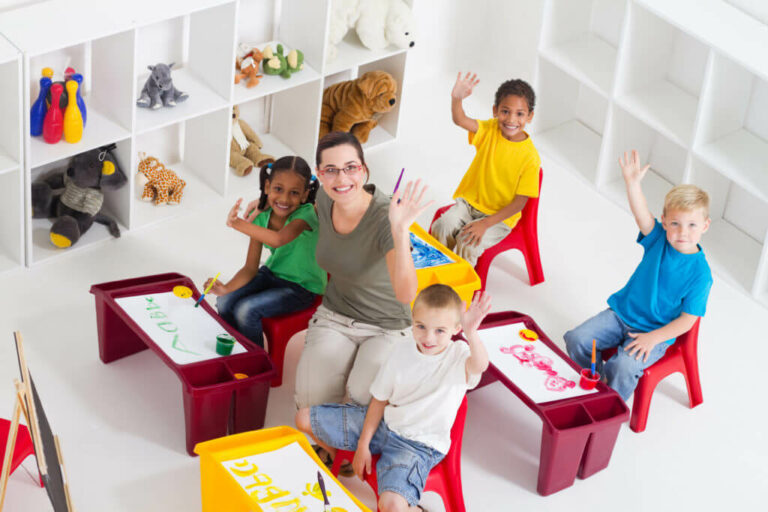
Play is important for early childhood development because it helps children build cognitive, language, social, emotional, physical, and self-regulation skills through active exploration. When children build, pretend, create, move, and interact with others, they are practicing problem-solving, communication, cooperation, creativity, and independence. In other words, play is not separate from learning. For young children, play is one of the most effective ways learning happens.
At Heritage Learning Center, we understand that children learn best when education is engaging, meaningful, and appropriate for their developmental stage. Family-owned and serving McKinney families since 1987, Heritage Learning Center combines experienced educators, research-based curriculum, hands-on experiences, and plenty of opportunities for purposeful play. Our three-acre McKinney campus includes turf playgrounds as well as sensory, phonics, and play rooms, giving children different environments in which to explore and grow. Our goal is to create a loving environment where education and fun work together, helping children develop the academic foundations, social skills, confidence, and curiosity they need for kindergarten and beyond.
How Play-Based Learning Supports Healthy Child Development
Play-based learning gives children opportunities to practice important skills in ways that feel natural and enjoyable. The American Academy of Pediatrics (AAP) reports that developmentally appropriate play with parents and peers promotes social-emotional, cognitive, language, and self-regulation skills while helping build executive function. The AAP’s clinical report on the power of play was reaffirmed in January 2025, underscoring the continued importance of play in healthy childhood development.
What Skills Do Children Learn Through Play?
Children can develop multiple skills at the same time during a single play experience. A child constructing a tower from blocks, for example, may be experimenting with balance and spatial relationships while also practicing patience, planning, and fine motor control.
Different forms of play can support development in different ways:
- Pretend play encourages imagination, language, storytelling, and perspective-taking.
- Building and construction play introduces problem-solving, spatial reasoning, early math concepts, and persistence.
- Active outdoor play strengthens gross motor skills, balance, coordination, and body awareness.
- Art and sensory play encourages creativity, exploration, fine motor development, and self-expression.
- Group play gives children practice with sharing, cooperation, communication, negotiation, and conflict resolution.
- Games with simple rules help children practice listening, remembering instructions, taking turns, and self-control.
The Center on the Developing Child at Harvard University also explains that playful activities can strengthen executive function skills, including attention, working memory, and basic self-control. These abilities become increasingly important as children enter more structured classroom environments.
How Does Play Prepare Children for School?
Play helps develop many of the skills children need to participate successfully in a classroom, not just academic knowledge.
Imagine several preschoolers deciding to build a pretend grocery store. They might sort pretend foods, count items, create signs, assign roles, negotiate who does what, and communicate with their “customers.” What looks like a simple game can incorporate early math, literacy, language, creativity, cooperation, and problem-solving.
Play can help children practice:
- Following directions and routines
- Focusing attention
- Communicating wants, needs, and ideas
- Working cooperatively with classmates
- Solving problems independently
- Managing frustration when something does not work
- Developing curiosity about new concepts
These abilities complement early literacy and math instruction and can help children become more confident, engaged learners.
Why Are Social and Emotional Skills Developed Through Play?
Playing with other children creates real opportunities to practice social skills rather than simply hearing about them. Children learn that another person may have a different idea, that everyone wants a turn, and that disagreements require solutions.
During age-appropriate group play, children can practice how to:
- Share materials and space
- Wait for a turn
- Express feelings with words
- Listen to another child’s ideas
- Negotiate roles and rules
- Handle disappointment
- Work together toward a common goal
The American Academy of Pediatrics notes that play also supports safe, stable, nurturing relationships with caregivers. Positive interactions during play can provide an important foundation for children’s social-emotional development.
At Heritage Learning Center, play-based learning is part of our approach to nurturing the whole child. Teachers can guide interactions when needed while also giving children room to make choices, explore ideas, and develop independence.
Does Outdoor Play Help Children Learn Too?
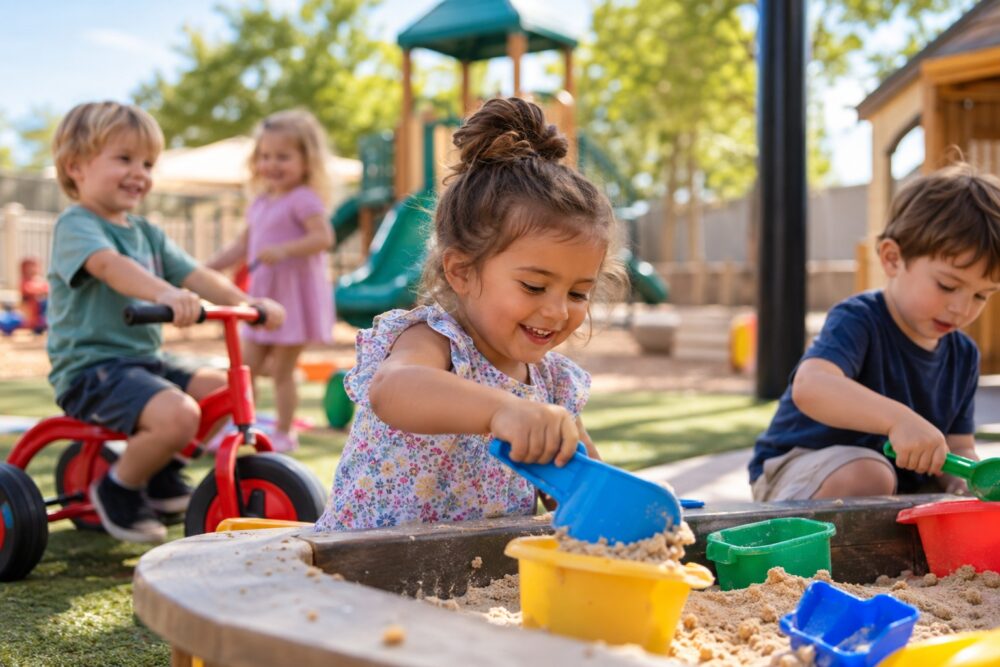
Yes. Outdoor play combines physical development with opportunities for discovery, creativity, problem-solving, and social interaction.
Running, climbing, jumping, balancing, and playing games help children strengthen large muscle groups and improve coordination. Outdoor spaces can also inspire different types of imaginative and cooperative play than children experience indoors.
McKinney families have excellent opportunities to continue active play beyond preschool. For example, Bonnie Wenk Park is a 216-acre city park with five playground structures, inclusive play elements, trails, fields, and other recreational amenities. Towne Lake Park is another large McKinney park with playgrounds, trails, a pond, and play features for varying ages.
Families do not need elaborate activities to make outdoor time educational. Ask your child to find different shapes in nature, count steps along a path, collect leaves to compare, invent a playground game, or tell you a story about something they see.
How Can Parents Encourage Learning Through Play at Home?
The best play activities are often simple. Expensive educational toys are not required. Everyday materials and a child’s imagination can provide meaningful learning opportunities.
Parents can encourage learning through play by:
- Providing blocks, crayons, puzzles, dress-up materials, and age-appropriate art supplies.
- Asking open-ended questions such as, “What do you think will happen next?”
- Letting children invent their own uses for safe household materials such as cardboard boxes.
- Playing simple matching, counting, sorting, or memory games.
- Reading a story and encouraging children to act it out afterward.
- Giving children regular opportunities for active outdoor play.
- Joining children’s play without controlling every decision.
One particularly helpful approach is to resist solving every small problem immediately. If a block structure falls over, ask, “What could we try differently?” That simple question turns frustration into an opportunity for experimentation and persistence.
Frequently Asked Questions About Learning Through Play
Is play really a form of learning for preschoolers?
Yes. Play gives preschoolers opportunities to practice language, early math, problem-solving, motor, social, emotional, and self-regulation skills. The AAP describes play as an important contributor to healthy development and learning.
What is the difference between free play and guided play?
Free play is primarily directed by the child, including what to play and how to play it. Guided play maintains children’s active involvement and choice while an adult thoughtfully supports learning through the environment, materials, questions, or gentle guidance. Both can play valuable roles in early childhood.
How much should adults direct children’s play?
Adults can provide safe environments, interesting materials, encouragement, and questions without directing every moment. Giving children opportunities to make choices and solve age-appropriate problems helps promote independence, creativity, and confidence.
Does play-based learning prepare children for kindergarten?
Yes. Quality play-based learning can strengthen attention, communication, self-regulation, cooperation, problem-solving, early literacy, early math, and independence. These skills support children’s transition into kindergarten and more structured learning environments.
Discover Play-Based Learning at Heritage Learning Center
Children do not have to choose between learning and having fun. Thoughtfully designed early childhood experiences can provide both.
At Heritage Learning Center, we believe purposeful play, caring teachers, engaging curriculum, and hands-on exploration can work together to help children become curious, capable, and confident learners. Since 1987, our family-owned center has served McKinney families with an environment designed to put children first.
Ready to see how play and learning come together at Heritage Learning Center? Contact Heritage Learning Center to learn more and schedule a tour of our McKinney campus.