Preschool can help ease separation anxiety by giving children repeated, positive experiences being apart from their parents in a safe and predictable environment. Consistent routines, caring teachers, familiar classmates, and dependable pickup times help children learn an important lesson: a parent can leave, the child can feel safe with trusted adults, and the parent will return.
At Heritage Learning Center, we understand that starting preschool can bring big emotions for both children and parents. Family-owned and operated in McKinney since 1987, Heritage Learning Center provides preschool programs for children beginning at 18 months, with experienced educators, engaging learning opportunities, and a supportive environment where children can build confidence and independence. For McKinney families preparing for this transition, preschool is about much more than early academics. It is also an opportunity for children to develop social-emotional skills, form relationships with trusted adults, practice new routines, and discover that they can thrive even when Mom or Dad is not right beside them.
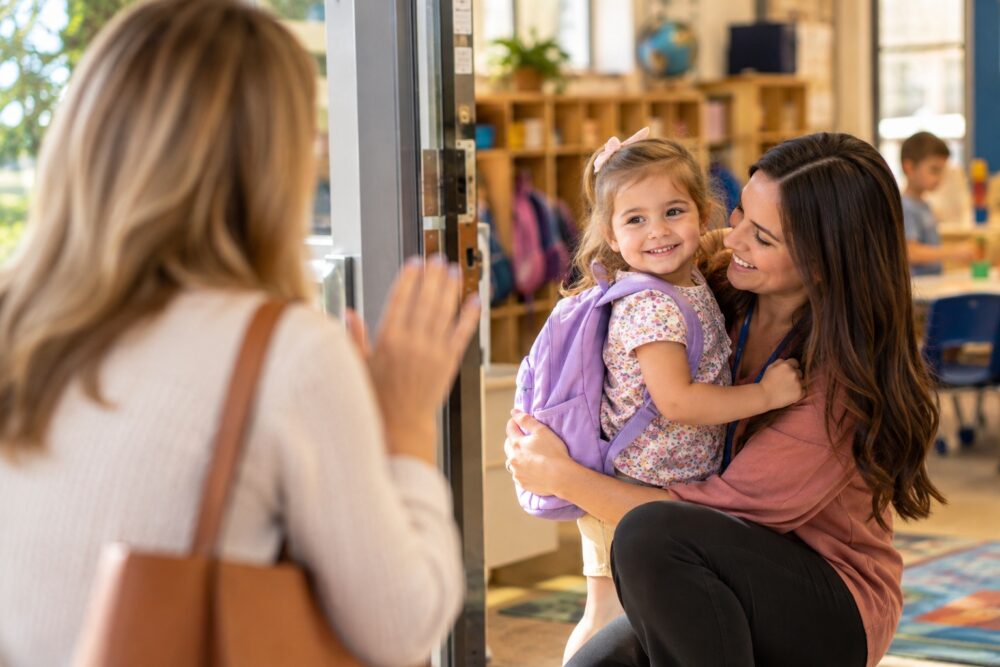
How a Consistent Preschool Routine Can Reduce Separation Anxiety
A predictable preschool routine can make separation feel less frightening because children gradually learn what will happen next. According to the National Association for the Education of Young Children (NAEYC), routines and rituals promote a sense of security because young children can anticipate what is coming, including the eventual return of their caregiver.
That predictability can transform preschool drop-off from an unfamiliar event into an ordinary part of a child’s day.
Why Does My Child Cry When I Leave Them at Preschool?
Crying at preschool drop-off is often a normal response to separation, especially when a child is adjusting to a new environment. Separation anxiety can involve crying, clinging, tantrums, or withdrawing, and NAEYC notes that these behaviors are not unusual through the preschool years.
A difficult goodbye also does not necessarily mean your child dislikes preschool. They may be reacting specifically to the moment of separation.
As the routine becomes familiar, children begin to understand the sequence:
- We arrive at preschool.
- Mom or Dad says goodbye.
- My teacher takes care of me.
- I play, learn, eat, and spend time with friends.
- Mom or Dad comes back.
Repeating that cycle helps build trust and confidence.
The American Academy of Pediatrics (AAP) recommends consistency during separation and emphasizes keeping promises about returning. It also suggests explaining pickup in terms children understand, such as “after nap time” rather than giving a clock time.
How Do Preschool Teachers Help With Separation Anxiety?
Supportive preschool teachers help children regulate their emotions, redirect their attention, and become comfortable with the classroom after a parent leaves.
Teachers can acknowledge a child’s feelings without making the separation seem alarming. For example, an educator might recognize that a child misses Mom while inviting them to join a favorite activity or sit with a trusted teacher for a story.
NAEYC recommends that early childhood educators help children identify feelings such as sadness or anger and remind them that their family member will return. Over time, a child can develop a secure relationship with the teacher and learn that other trusted adults can provide comfort and support.
This is one reason the preschool environment matters. Heritage Learning Center emphasizes a loving environment, experienced educators, social-emotional development, and age-appropriate programs designed to help children grow in confidence and independence.
What Can Parents Do to Make Preschool Drop-Off Easier?
A short, loving, and consistent goodbye is generally more helpful than a long or unpredictable departure.
The AAP recommends creating a quick goodbye ritual and using it consistently. Lingering can prolong the transition, while returning after saying goodbye may cause the separation process to begin all over again.
Parents can help by:
- Creating the same simple goodbye ritual each morning
- Telling their child clearly that they are leaving
- Reassuring them that they will return
- Keeping the actual goodbye brief
- Arriving and picking up as consistently as possible
- Talking positively about teachers, classmates, and preschool
- Practicing short separations before preschool begins
- Asking whether a comfort item or family photo is appropriate for the classroom
Avoid sneaking away when your child is distracted. ZERO TO THREE and NAEYC both advise against leaving without saying goodbye because it can make children more worried about when a parent might disappear again.
For McKinney parents considering preschool, visiting the campus together before the first regular day can also help make the environment feel familiar. Heritage Learning Center offers both full-day and part-time preschool options, which gives local families choices when determining the schedule that fits their child and household.
How Long Does Separation Anxiety Last When Starting Preschool?
There is no single adjustment timeline because every child’s temperament, previous experiences, and developmental stage are different.
Some children settle quickly, while others need more time and reassurance. NAEYC notes that it can sometimes take up to 10 school days for a child to fully settle into a new routine. A slower adjustment does not automatically indicate a problem.
What matters is the overall pattern. Parents and teachers can look for gradual signs of progress, such as shorter periods of crying, greater willingness to enter the classroom, talking positively about a teacher, participating in activities, or becoming excited to see classmates.
Children who are naturally cautious about new situations may simply need additional time. The AAP notes that temperament affects how children respond to change and recommends predictable routines and gradual introductions for children who adapt more slowly.
When Should Parents Be Concerned About Separation Anxiety?
Parents should seek additional guidance when anxiety is persistent, severe, or significantly interferes with a child’s everyday life.
Occasional tears at preschool drop-off are different from anxiety that prevents a child from participating in normal activities or causes continuing significant distress. The AAP recommends talking with your child’s pediatrician when a child is not adapting to separation or when anxiety interferes with day-to-day life.
Parents should also communicate with their child’s preschool teacher. Comparing what happens at drop-off with what happens five, 15, or 30 minutes later can provide valuable context. A child who cries intensely when a parent leaves but soon begins playing may be having difficulty with the transition itself rather than the entire preschool experience.
Frequently Asked Questions About Preschool Separation Anxiety
Is separation anxiety normal when starting preschool?
Yes. Separation anxiety is a normal developmental experience, and some children continue to have difficulty with goodbyes during the preschool years. Consistent routines and supportive caregivers can help children gradually become more comfortable.
Should I leave preschool if my child is crying?
Once your child is safely with a trusted teacher and you have completed your goodbye routine, a brief and consistent departure is generally recommended. The AAP advises parents not to repeatedly return after leaving, because doing so can restart the separation process.
Should I sneak out if my preschooler gets upset?
No. Experts recommend saying goodbye rather than disappearing without warning. A predictable goodbye helps children learn that parents leave openly and reliably return.
Can part-time preschool help a child adjust to separation?
For some children, a part-time schedule can provide a gradual introduction to being away from home while still establishing a dependable school routine. Heritage Learning Center offers part-time preschool options for eligible two-, three-, and four-year-olds in McKinney, including morning and three-day schedules.
Help Your Child Build Confidence at Heritage Learning Center
Separation anxiety can make the first days of preschool emotional, but those difficult goodbyes can also become opportunities for growth. With consistent routines, supportive teachers, positive classroom experiences, and a strong partnership between home and school, children can learn that they are safe, capable, and ready to explore their world with greater independence.
For McKinney families, Heritage Learning Center provides a nurturing environment where education, play, relationships, and social-emotional development work together to help young children thrive. Contact Heritage Learning Center to schedule a tour and learn more about preschool programs in McKinney, TX.